This page is the public documentation shelf for the most important document layers behind x64base, DotTalk++, DotScript, DotTalk++ Workbench, and the Laboratory Campus.
The website is not meant to be a hand-written brochure. It is a reviewed publication surface built from the same vertical documentation system used by the runtime: source comments, usage contracts, HELP, metadata, SelfDoc reports, MDO organization, manualgen, diagrams, and AI-friendly summaries.
This is the working thesis of the documentation system: x64base should be able to use its own metadata and documentation infrastructure to describe, validate, and increasingly prove itself. The website is one reviewed output of that loop, not the loop itself.

The most important documents are not one flat folder. They move through parallel lanes: source/runtime proof, HELP explanation, metadata normalization, SelfDoc review, provenance preservation, and promotion into manuals, diagrams, and the website.
Diagram Attachment Governance
The diagram lane now has an explicit attachment map in the implementation tree:
docs/manuals/developer/manualgen/reports/diagram-publication-attachment-matrix-v1.csv
That matrix exists so images on the site do not drift into orphan visuals with no canonical home. Each promoted diagram should answer:
- Which canonical source asset or Mermaid/Draw.io source owns it?
- Which manual chapter consumes it?
- Which public page consumes it?
- What proof level and review status does it carry?
Current promoted site image families already visible here include:
- SelfDoc / publication SDLC images under
public/images/sdlc - runtime evidence screenshots under
public/images/evidence - LabTalk campus/proof diagrams under
public/images/labtalk
The goal is to keep diagrams attached to the same evidence spine as manuals and command documentation, not to let image assets become a parallel undocumented truth system.
Document Layers
| Layer | Role | Website Status |
|---|---|---|
| Source and runtime truth | C++ source, command registration, headers, contracts, runtime transcripts, and command behavior. | Referenced and summarized; not fully mirrored. |
| HELP and metadata | HELP, CMDHELP, command/function catalogs, usage contracts, field/type metadata, and validation readback. | Command and function pages should be regenerated from this layer. |
| SelfDoc reports | Report-only extracts for features, contracts, comments, evidence, diagrams, and crosswalks. | Selected reports are promoted after review. |
| MDO organization | Master Documentation Organizer structure for lanes, manuals, evidence, sections, and promotion decisions. | Public pages should cite the organized lane, not raw scanner guesses. |
| AI-friendly artifacts | Compact summaries, manifests, crosswalks, inventories, and review notes designed for model-assisted maintenance. | Should be exposed when reviewed and clearly marked as derivative. |
| Manualgen outputs | Generated manual inventories, validation reports, dry-runs, and accepted manual sections. | The sealed 183-page reference remains the reviewed public checkpoint; the current 191-page, 26-part assembled candidate is a separately labeled local preview. |
| Website derivatives | Public pages under x64base.com that present reviewed, status-labeled slices of the above. | This site is the current publication surface. |
Current Public Anchors
- Current Tasks & Projects is the maintained view of AI Portal tickets, project status, owners, proof state, Pseudo-Chat returns, and next gates.
- Full-stack Documentation Push records the current bottom-to-top vertical from source contracts through local website review.
- Historical Source Lineage restores the compact xBase → XDLL/xBase2 → DotTalk family tree, preserves recovery branches, and labels the modern x64base/DotTalk++ continuation without inventing ancestry.
- Historical Family Tree is the readable hierarchy page; its CSV companion is explicitly labeled as a download.
- Historical xBase Source Files opens the 21 canonical archive members as read-only text with timestamps and SHA-256 hashes.
- Current Project Truth records conservative wording rules and the observed implementation state.
- Current Work Lanes lists active, canary, planned, and integration lanes without crowding the front page.
- Documentation Progress records the nine-gate publication checkpoint, accepted manual metadata, current follow-up delta, and separate missions.
- Pinocchio Engine Benchmarks preserves the historical before/after table, the maintainer-attested machine identity, and the next reproducible benchmark gate.
- Website Documentation Matrix maps website sections to source lanes, data-mining feeds, proof artifacts, and publication status.
- SelfDoc Feed Pipeline documents the repeatable report-only path from source to manuals and website pages.
- HELP, Message, and SelfDoc DFD maps the complete context, runtime, validation, proof, curation, manual, and publication flow across four source-derived diagram levels.
- SelfDoc Website Publication defines the boundary between implementation truth and public website copy.
- Public Site Architecture separates the x64base.com development/conception role, the dottalkpp.com lean-entry role (updated 2026-08-11, AIF-107), and the governed connections between them.
- Coding Standards records contracts, usage comments, header conventions, and safeguards.
- Runtime Evidence Gallery curates screenshots as evidence artifacts, not marketing screenshots.
- Engine Feature Crosswalk summarizes engine features from a generated SelfDoc report.
- Command Catalog and Function Catalog are public catalog derivatives that should eventually be regenerated from HELP/metadata/contract evidence.
- Accepted Developer Manual is the current manual-reviewed Markdown artifact.
- DotTalk++ Command Reference separates the accepted 183-page checkpoint from the current 191-page local candidate.
- RAM DBF and VDISK records the transient in-process storage contract.
- Identity, Authentication, and RBAC records the USER model and the legacy SECURITY boundary.
dottalkpp.com -- The Lean Entry Site
x64base.com is the development and conception site. dottalkpp.com (role updated
2026-08-11, AIF-107) is the lean public entry surface: static HTML, six nav
items, an evidence-tiered status board, changelog instead of news. It is
versioned in deraldg/dottalkpp and deployed through GitHub Pages:
The separate DotTalk++ artifact domain is not linked publicly while its HTTPS certificate is unhealthy.
The artifact manifest must carry proof status, review status, and accessibility status so public links do not outrun the evidence behind them.
Published checkpoint and current candidate
The reviewed 2026-07-18 snapshot is now public as a Markdown download. It contains 4,118 lines, 237 headings, 24 sections, and four appendices. Its command-reference companion contains 183 standalone pages: 164 linked from the reader and 19 supplemental pages.
- Proof label:
manual-reviewed.
The current local candidate is a separate 26-part, 14,542-line assembly. It binds 191 command pages—164 reader-linked, 19 supplemental, and 8 post-baseline repairs—with 4,604 lineage rows. Its stable HTML, PDF, Markdown, and build manifest are staged for local review but do not replace the sealed public checkpoint until the remaining publication gates pass.
- Public source snapshot:
be935053. - Acceptance evidence: primary reader manifest.
Publication is a checkpoint, not the end of the feed. Later manual updates should appear here only after they are generated, validated, and reviewed. The repeatable path remains:
source behavior
-> comments and @dottalk.usage / @dottalk.contract headers
-> HELP, CMDHELP, metadata, and comments evidence
-> CMDHELPCHK / SelfDoc validation reports
-> MDO section organization
-> manualgen inventory / validate / dry-run
-> reviewed manual section
-> website manual page or downloadable artifact
This keeps the public manual honest. If a feature is runtime-evidenced, the manual can say so. If it is source-evidenced, canary, planned, or review-needed, the manual should carry that status instead of smoothing it over.
The current follow-up delta is intentionally visible but not over-promoted:
Pinocchio benchmark metadata, comments-audit closeout records, and the full
documentation-run evidence still need a reviewed public-source promotion
before they can become durable public provenance. METACOLLECT-238 remains a
separate 238-finding mission rather than an implied part of the completed run.
Manual / Website Boundary
The manual and website can exchange reviewed material, but the direction matters. The normal flow is simplex: implementation truth feeds SelfDoc/MDO/manualgen, then reviewed manual sections and website pages. The website should not become the manual's source of technical truth.
The manual may take from the website only when the target artifact is website-owned, separately maintained, and not derivable from the implementation checkout. Examples include curated screenshots, public-only media, navigation framing, contact details, branding, and hosted-download metadata. For commands, functions, file formats, engine features, index behavior, table buffering, or DotScript syntax, the manual must return to source/runtime/HELP/metadata/SelfDoc evidence instead of copying website prose.
README.* files have a stricter preservation rule. They are orientation and
provenance artifacts, not disposable generated output. A README may be improved
or superseded, but if it is replaced the prior version must be preserved as a
versioned artifact so the project history remains auditable.
AI-Friendly Documentation
AI-friendly documents are useful because the project is broad, but they are not the source of truth by themselves. They should preserve:
- source path or report path,
- generation date or extraction snapshot,
- evidence status,
- mutation boundary,
- review state,
- promotion target.
AI-friendly summaries are allowed on the website when they help a reader navigate the system and when they remain traceable back to source, HELP, SelfDoc, MDO, or manualgen artifacts.
Website Generation Rule
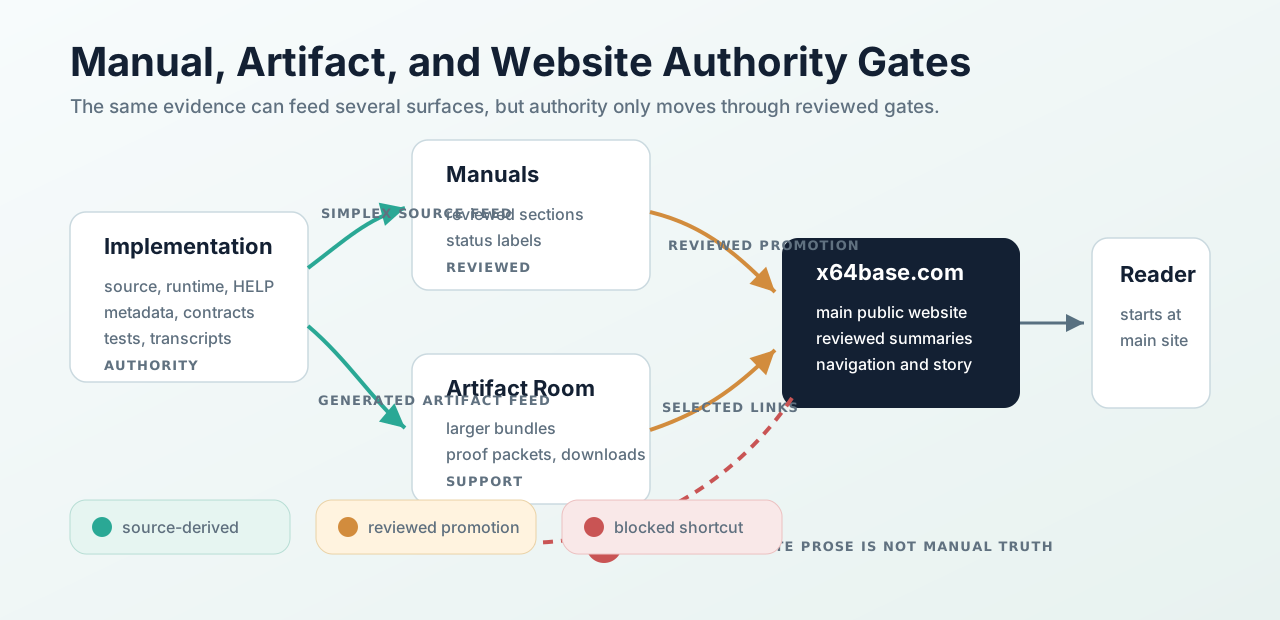
The website should increasingly be maintained by vertical content generation:
implementation truth
-> SelfDoc / MDO / manualgen / AI-friendly reviewed artifacts
-> public website derivatives
-> x64base.com published documentation
Hand edits are acceptable for framing and review, but important technical pages should be fed by repeatable reports whenever possible.