Canonical diagram
Diagram attachment: DIAG-INDEXARCH-007
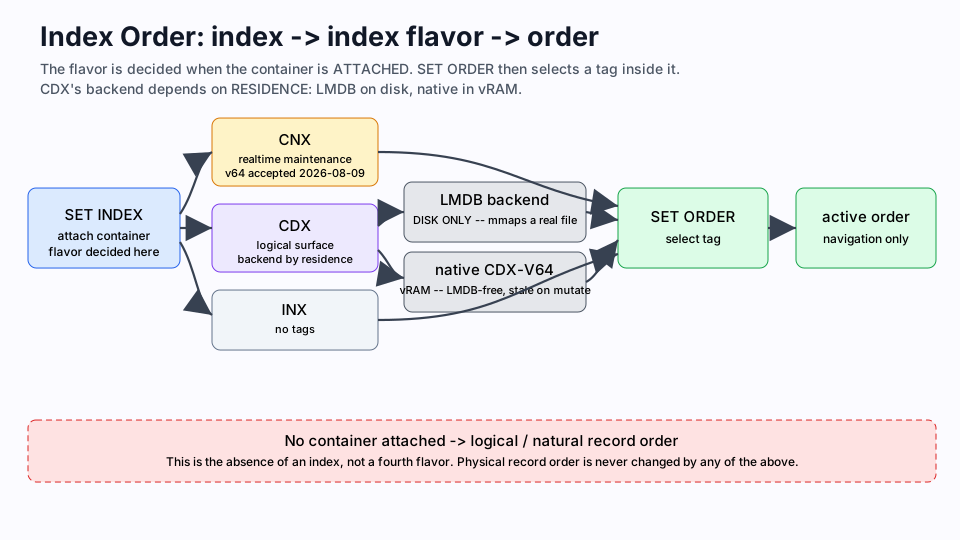
Canonical source:
docs/manuals/assets/diagrams/index_order_cdx_lmdb_v1.svg
Teaching Model
The learner-visible model is a chain, and the order of its links is the lesson:
index -> index flavor -> order
- A table stores records.
SET INDEXattaches a container. This is where the flavor is decided --.cnx,.cdxor.inx-- not later.SET ORDERselects a named tag inside the flavor already chosen.- An active order changes navigation without changing physical record order.
With no container attached you get logical, natural record order. That is the absence of an index rather than a fourth flavor.
CDX's backend depends on where the table lives
This is the part most easily got wrong, because "CDX means LMDB" is true only on disk:
| residence | CDX backend | maintains on mutation? |
|---|---|---|
| disk | LMDB environment | yes |
| vRAM | native CDX-V64 | no -- marks the container stale |
LMDB cannot live in vRAM. include/xbase/ramfs.hpp states the reason
plainly: LMDB "must mmap a real OS file", and the RAM filesystem has none. So
index_manager.cpp routes RAM-resident tables to a "native CDX-V64 backend
(uint64, LMDB-free) served from RAM", skipping the LMDB environment gate
entirely. That native backend does not incrementally maintain: its upsert and
erase mark the container stale and a rebuild reconstructs it.
Why CNX was reactivated for v64
That constraint is the reason, and it is worth stating as cause and effect rather than as two unrelated facts.
CNX gained realtime index maintenance specifically to serve RAM-resident
tables -- cnx_backend.cpp says the RAM/vdisk case is "the case this milestone
exists to serve". Since LMDB-backed CDX is unavailable in vRAM and native CDX
goes stale on mutation, CNX is the flavor that stays correct there.
So an owner ruling on 2026-08-09 reactivated CNX for v64 tables: an explicit
.cnx is accepted on a v64 table with an advisory, where it was previously a
hard refusal. Two things did not change, and both matter:
- The default is untouched. With no extension given, v64 still resolves to
.cdx. CNX only auto-resolves when a.cnxexists and no.cdxdoes, and it says so: "no .cdx container found; using existing CNX (LMDB-backed CDX is the preferred x64 index)." - Nothing substitutes automatically. The engine does not swap CDX for CNX
because a table is in RAM. The choice is explicit and travels per table in
the workspace posture (
index=/indextype=), which is what lets one workspace mix CNX, CDX and INX.
CDX is the container, creator, and manager surface for indexes in the xBase lineage. LMDB is the embedded database technology used underneath the modern x64base implementation on disk.
Source Evidence
The current source tree shows this split in several places:
include/cdx/cdx.hppdefines the minimal CDX container contract: header I/O, table binding, tag directory read/write, and add/drop tag operations.src/cli/cmd_cdx.cppexposes CDX container management commands.src/cli/cmd_buildlmdb.cppbuilds or rebuilds the LMDB backing store for a CDX container.src/cli/cmd_setorder.cppdocuments the policy: disk-resident v64 tables use a CDX container backed by LMDB; public CDX paths resolve underINDEXES, while backend LMDB paths resolve underLMDB. The same file carries the 2026-08-09 CNX-on-v64 ruling and its advisory.src/cli/cmd_setindex.cppcalls itself a "Flavor-aware decision flow" and is where the flavor is chosen: classic xBase/VFP accepts.inx/.cnx, true x64/v128 prefers.cdx. Attach and tag activation are "two related decisions" -- which is theindex -> index flavor -> orderchain above.include/xbase/ramfs.hpprecords why the vRAM lane differs: LMDB "must mmap a real OS file", so it is out of scope for the RAM filesystem.src/xindex/index_manager.cpproutes RAM-resident tables to the "native CDX-V64 backend (uint64, LMDB-free) served from RAM", skipping the LMDB environment gate.src/xindex/cdx_native_backend.cppstates the native backend's limit in its own comment: it "does not incrementally maintain on mutation in v1", soupsertanderasemark the container stale.src/xindex/cnx_backend.cpprecords why CNX gained realtime maintenance: "RAM/vdisk tables are the case this milestone exists to serve."docs/cases/CASE_ENG_010_INDEX_NAVIGATION_CDX_LMDB.mdstates the teaching rule directly: CDX is the user-facing logical container, and LMDB is a backend implementation detail.
Operational Flow
DBF_64 / table area
  -> CDX container
       -> tag directory
       -> table binding
       -> logical order names
  -> BUILDLMDB
       -> LMDB environment
       -> named backend databases for tags
  -> SET ORDER / SEEK / INDEXSEEK / LIST_LMDB
       -> ordered navigation and diagnostics
In the lab campus, this gives us a clean horizontal slice. A student can see record storage, index metadata, backend materialization, and navigation behavior as separate layers of the same system.
Command Surface
| Command area | Role |
|---|---|
CDX | Create and inspect the logical CDX container and tag directory. |
SETCDX | Attach a CDX container to the current work area. |
BUILDLMDB | Materialize or rebuild the LMDB backend for the current CDX/tag model. |
SETLMDB | Attach or configure the LMDB backend path where needed. |
SET ORDER | Activate a logical tag/order for navigation. |
INDEXSEEK | Seek through index-backed navigation. |
LIST_LMDB / LMDBDUMP / LMDB_UTIL | Inspect backend state for diagnostics and advanced lessons. |
Why This Fits LabTalk
LabTalk is a laboratory campus, so the index system should be presented as a set of rooms:
- Records room - physical table rows and record numbers.
- Container room - CDX headers, table binding, and tag directory.
- Backend room - LMDB environment, named databases, and rebuild lifecycle.
- Navigation room -
SET ORDER,SEEK,SKIP,TOP, andBOTTOM. - Diagnostics room - command output, case stories, runtime proofs, and SelfDoc contracts.
This lets the same feature serve CS101, database history, systems programming, and advanced runtime inspection without changing the underlying architecture.
Third-Party Credit
LMDB is the Lightning Memory-Mapped Database Manager by Howard Chu / Symas and the OpenLDAP project. The official LMDB home page is Symas LMDB, and the documentation is available at lmdb.tech.
Project-wide library credits are maintained in Third-Party Credits.