x64base is the synthesis of three threads that started in 1993:
- Practical engineering — building stable data tools that keep working year after year.
- Teaching — treating file formats and relational thinking as learnable, inspectable systems.
- Historical continuity — respecting the xBase lineage while modernizing it for 64-bit systems.
From the beginning, the aim was transparent computing: you can open the files, understand the structures, and reason about performance and correctness without magic.
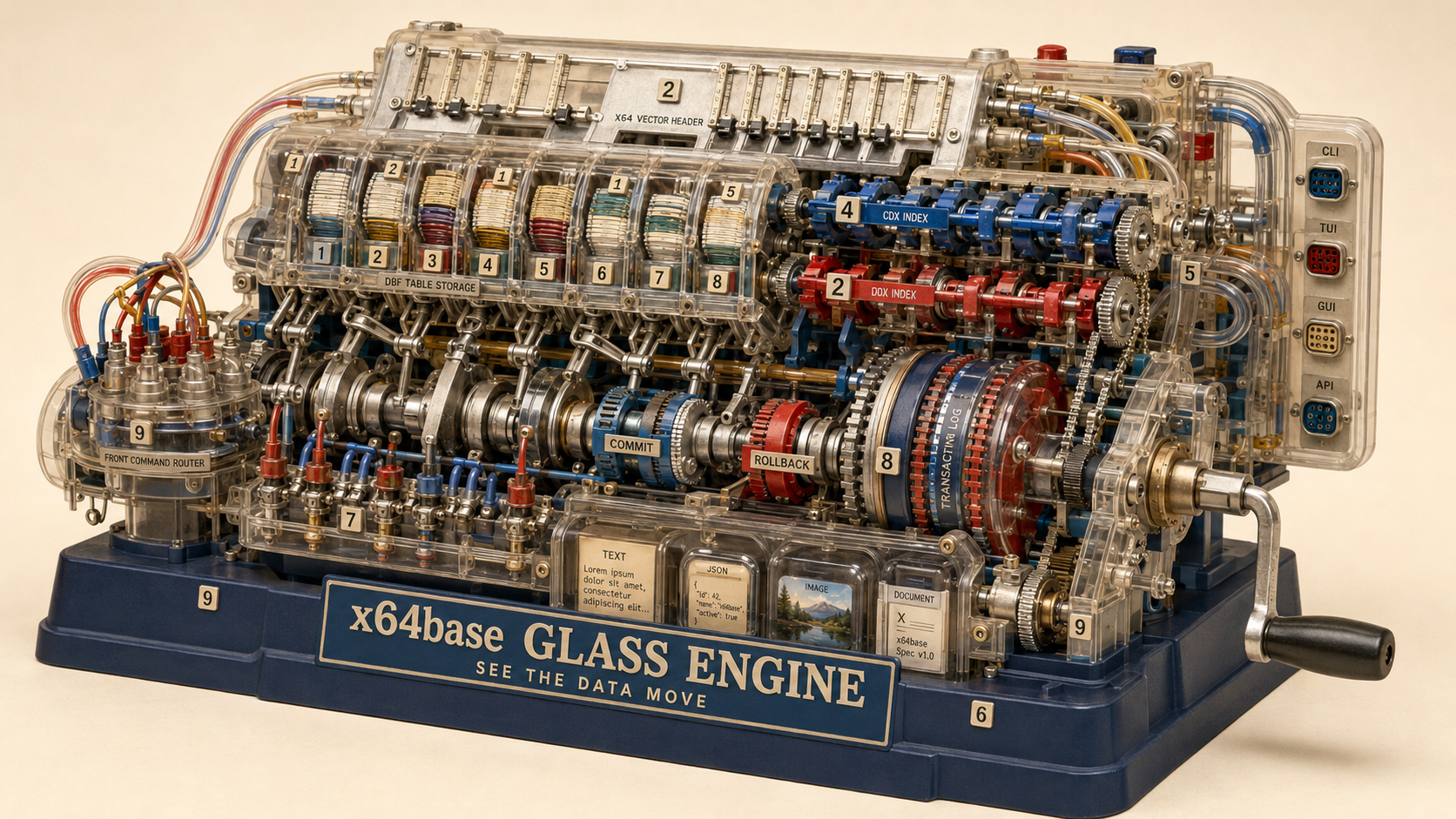
Click the image for the full-resolution view.
The transparent-engine idea
The glass-engine metaphor is close to the transparent educational engine models of the 1960s and 1970s: the point was not decoration, but visibility. A learner could see pistons, rods, gears, and timing relationships that would normally be hidden inside metal. x64base and DotTalk++ carry the same idea into database software: tables, headers, memos, indexes, work areas, buffers, HELP text, metadata, contracts, and proof artifacts should be inspectable instead of sealed behind a black box.
By 2026, that mindset has an ecosystem around it:
- A canonical 64-bit engine (DBF_64 + FPT64)
- A learning-first scripting language (DotTalk++)
- Focused CLI and front-end tools (TupTalk / TableTalk / RelTalk / Parallel GUI/TUI)
- A free learning campus with a non-profit frame (Laboratory Campus / LabTalk)
- A self-documenting protection layer (SelfDoc + MDO)
Each of those carries its own maturity label elsewhere on this site, and several are alpha. The list says the pieces exist and fit together, not that any one of them is finished.
SelfDoc and the Master Documentation Organizer arose from two needs at once: to explain the system as it grew, and to protect the source tree and generated artifacts from accidental damage during AI-assisted development. The goal is not to reject AI assistance; it is to make every AI-assisted change reviewable, traceable, and bounded by source truth, usage contracts, proof scripts, and human release judgment.
This website organizes that ecosystem into a stable, readable structure: product pages, documentation, licensing, curriculum, and brand foundations.